Getting Ready is Easier Than You Think
Greater New Orleans Area
Free, No-Obligation Estimates
Lifetime Warranties Available
Over 10 Years of Experience
Request Estimate
Hero Request Form
Thank you for contacting us.
We will get back to you as soon as possible.
Please try again later.
Documents You'll Need
- Bullet text
- Bullet text
- Bullet text
- Bullet text
- Bullet text
- Bullet text
- Bullet text
- Bullet text
- Bullet text
- Bullet text
Title or Question
Describe the item or answer the question so that site visitors who are interested get more information. You can emphasize this text with bullets, italics or bold, and add links.Title or Question
Describe the item or answer the question so that site visitors who are interested get more information. You can emphasize this text with bullets, italics or bold, and add links.Title or Question
Describe the item or answer the question so that site visitors who are interested get more information. You can emphasize this text with bullets, italics or bold, and add links.
Gallery Heading H2

The Reliable Foundations Process
From Grant Readiness to Project Completion, We Help You Move Forward
Home elevation projects involve more than construction. Before a home can be lifted, homeowners may need to gather documents, review funding options, coordinate surveys and engineering, wait for agency review, finalize contracts, and prepare for construction.
Reliable Foundations helps simplify that process.
Our team works with homeowners to understand what information is needed, prepare for each stage, coordinate project planning, and complete the elevation and foundation work with clear communication from start to finish.
The timeline below shows how we help guide homeowners from the first consultation through final inspection and project closeout.
Every home elevation project is different, but most follow a similar path. Reliable Foundations helps homeowners understand what comes next, stay organized, and prepare for the construction phase once funding, approvals, and project requirements are in place.
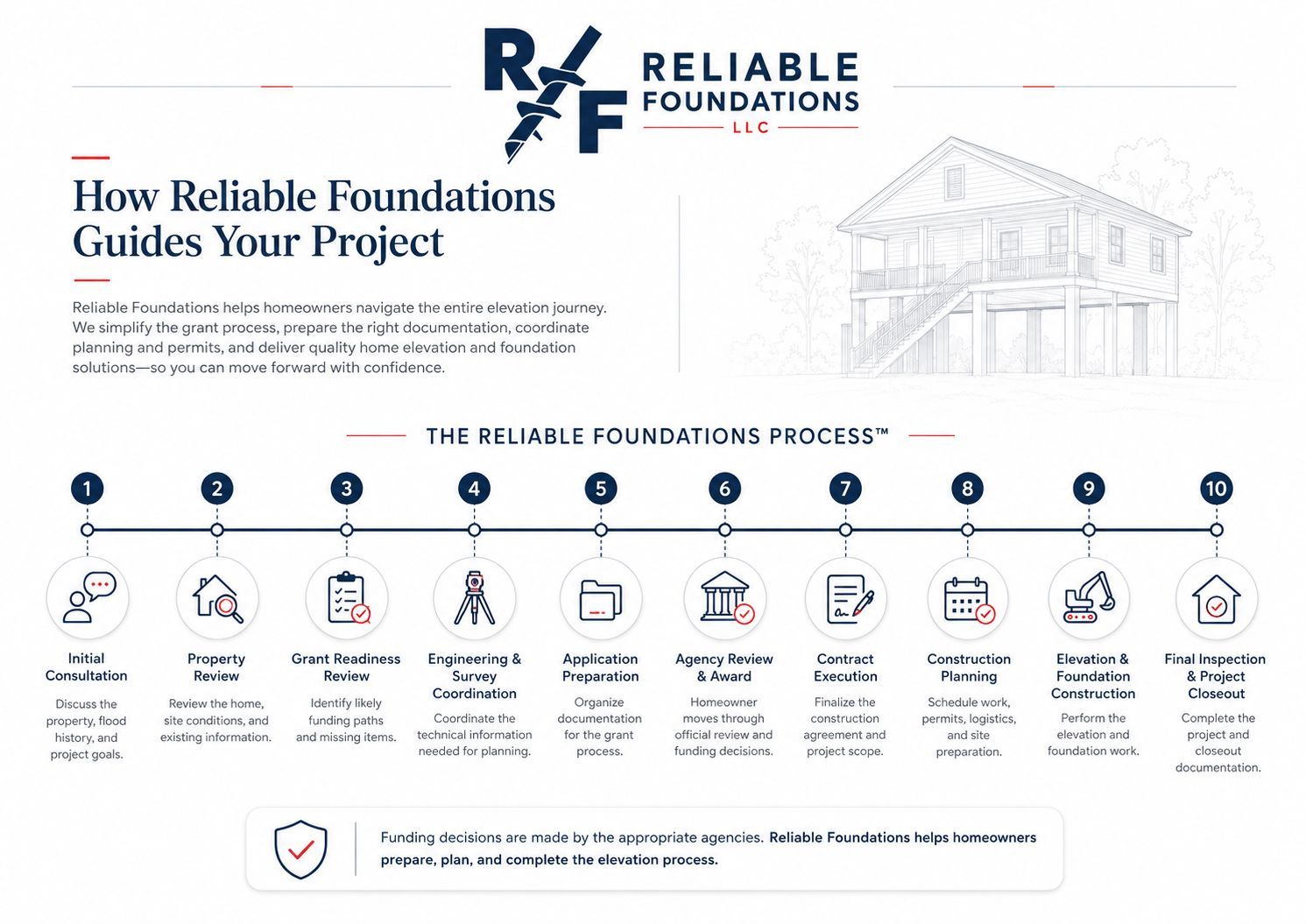
Funding decisions are made by the appropriate agencies and program administrators. Reliable Foundations helps homeowners prepare, plan, coordinate, and complete the elevation and foundation construction process.
How Reliable Foundations Help
Reliable Foundations is not just a construction contractor. We help homeowners understand the full elevation process before the work begins.
We can assist with:
- Grant Readiness Review - We help homeowners understand what documents and project information may be needed before moving forward.
- Planning Coordination - We coordinate with the appropriate project professionals, including surveyors, engineers, and permitting contacts, when needed.
- Construction Preparation - We help homeowners understand what to expect before construction begins, including scheduling, site preparation, access, utilities, and project logistics.
- Elevation & Foundation Construction - Our team completes the structural elevation and foundation work using proven construction methods and clear project communication.
- Project Closeout - We help homeowners understand final inspection, closeout documentation, and next steps after the project is complete.
Ready to Start the Process?
The first step is understanding where you are today and what information may be needed next by clicking "Download the Grant Checklist".
Frequently Asked Questions
Home elevation, FEMA funding, insurance, and construction can feel overwhelming at first. These frequently asked questions explain the basics homeowners usually want to understand before starting the grant preparation and elevation process.
Reliable Foundations helps homeowners get organized, understand what may be needed, and move through the planning and construction process with confidence.
Funding & Grant Questions
What FEMA-related funding programs may help with home elevation?
The most common FEMA-related funding paths homeowners hear about are HMGP, FMA, and ICC. HMGP may become available after a presidentially declared disaster, FMA is focused on reducing repetitive flood damage to NFIP-insured buildings, and ICC may help certain NFIP policyholders pay for required floodplain compliance work.
Does Reliable Foundations approve FEMA grants?
No. Reliable Foundations does not approve FEMA grants, insurance claims, or funding awards. Those decisions are made by the appropriate federal, state, local, parish, municipal, or insurance-related authorities.
Our role is to help homeowners understand the process, prepare for the project, coordinate required planning, and complete the elevation and foundation work if the project moves forward.
Can Reliable Foundations help me apply for FEMA funding?
Reliable Foundations can help homeowners understand what information is typically needed, gather project-related documents, coordinate with surveyors and engineers when needed, and prepare for the construction portion of an elevation project.
We do not guarantee approval, but we help homeowners become more organized and better prepared.
What is HMGP?
HMGP stands for Hazard Mitigation Grant Program. FEMA describes HMGP as a program that provides funding to state, local, tribal, and territorial governments to help communities reduce future disaster losses. When requested by an authorized representative, this funding may be available after a presidentially declared disaster.
What is FMA?
FMA stands for Flood Mitigation Assistance. FEMA describes FMA as a competitive grant program that provides funding to states, local communities, federally recognized tribes, and territories for projects that reduce or eliminate repetitive flood damage to buildings insured by the National Flood Insurance Program.
What is ICC?
ICC stands for Increased Cost of Compliance. ICC is coverage through the National Flood Insurance Program that may help qualifying policyholders pay part of the cost to elevate, relocate, demolish, or floodproof a structure when required to meet floodplain compliance
standards. FEMA states that ICC may provide up to $30,000 for eligible mitigation measures.
Can I choose Reliable Foundations as my contractor if I receive funding?
In many cases, homeowners may be able to work with a qualified contractor of their choice, but contractor selection rules can vary depending on the funding program, grant agreement, local administrator, and project requirements.
Before signing any agreement, homeowners should confirm the rules with the agency or program administrator handling their application.
Will FEMA pay the contractor directly?
Payment procedures vary by program, administrator, and grant structure. Some programs may involve reimbursement, staged payments, inspections, or payment through a local or state administrator.
Homeowners should confirm the payment process with the agency managing their grant or insurance claim before construction begins.
Getting Started Questions
What documents should I gather first?
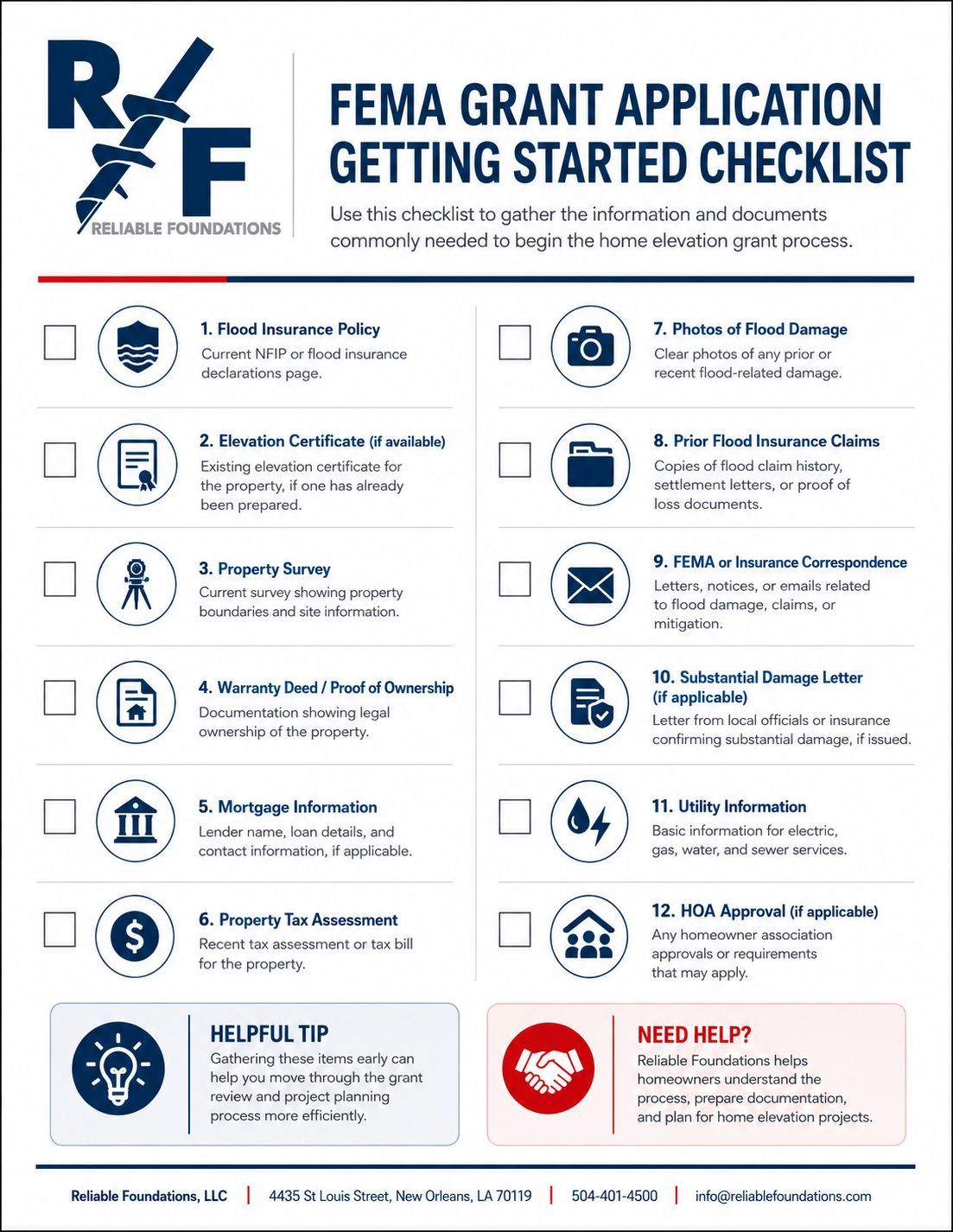
A good starting point is to gather:
- Flood insurance policy or declarations page
- Elevation certificate, if available
- Property survey
- Warranty deed or proof of ownership
- Mortgage information
- Property tax assessment
- Photos of flood damage
- Prior flood insurance claim documents
- FEMA or insurance correspondence
- Substantial damage letter, if one has been issued
- Utility information
- HOA documents, if applicable
These documents help create a clearer picture of the property, flood history, insurance status, and project requirements.
What if I do not have all of the documents yet?
That is very common. Many homeowners start the process with only some of the required information.
The first step is identifying what you already have and what still needs to be gathered. Reliable Foundations can help you understand which documents may be helpful before moving forward.
Do I need an elevation certificate?
An elevation certificate is often helpful because it documents important elevation information about the property. FEMA explains that elevation information may be used to show compliance with local floodplain management requirements and may also be used by property owners for flood insurance purposes.
What if I do not have an elevation certificate?
If you do not have one, that does not necessarily mean you cannot begin the conversation. Reliable Foundations can help you understand when an elevation certificate may be needed and whether a surveyor or other professional should be involved.
What is a substantial damage letter?
A substantial damage letter is typically issued by a local building or floodplain official when damage to a structure reaches a level that may trigger floodplain compliance requirements.
If you receive one, keep a copy. It may be important for insurance, permitting, FEMA-related review, and project planning.
Do I need flood insurance?
Some funding paths are tied to flood insurance. For example, FMA focuses on buildings insured by the National Flood Insurance Program, and ICC is coverage associated with NFIP policies.
Even when flood insurance is not the only factor, your insurance status is one of the first items to review when evaluating potential funding options.
How do I know if my home is in a flood zone?
Flood zone information is usually determined through FEMA flood maps, local floodplain records, elevation certificates, surveys, or insurance documentation.
Reliable Foundations can help homeowners understand what information may be needed, but official flood zone determinations should be confirmed through the appropriate mapping, insurance, or local floodplain authority.
Construction & Project Questions
How long does the home elevation process take?
The timeline varies depending on funding review, documentation, engineering, permitting, weather, utility coordination, site conditions, and construction scope.
In many cases, the approval and planning process takes longer than the physical elevation work, which is why it is important to begin gathering documents early.
Do I have to move out during construction?
In most elevation projects, homeowners should expect that the home will not be livable during at least part of the construction process.
Utility disconnections, structural lifting, foundation work, inspections, and site access requirements can affect whether the property can be occupied.
Will my utilities need to be disconnected?
Yes. Electric, gas, water, sewer, HVAC, and other systems usually need to be reviewed before elevation work begins. Some utilities may need to be disconnected, protected, relocated, extended, or reconnected depending on the project.
Can a slab home be elevated?
Some slab homes may be elevated, but they require careful evaluation, engineering, and planning. The feasibility depends on the structure, foundation system, site conditions, elevation requirements, and project budget.
Reliable Foundations can review the property and explain what options may be available.
Can a raised home or pier-and-beam home be elevated higher?
In many cases, raised homes or pier-and-beam homes may be candidates for elevation, depending on the structure and existing foundation conditions.
A site inspection is needed to determine the safest and most practical approach.
Will my stairs, porches, and access points need to be changed?
Often, yes. When a home is elevated, stairs, landings, porches, ramps, railings, utilities, driveways, walkways, and access points may need to be adjusted to meet code and project requirements.
Will the project require permits?
Most elevation and foundation projects require permits and inspections. Specific requirements depend on the local jurisdiction, floodplain requirements, project scope, and construction plans.
What happens after the home is elevated?
After elevation work is completed, the project may require final inspections, utility reconnection, closeout documentation, insurance updates, and any grant-related closeout paperwork required by the program administrator.
Insurance & Floodplain Questions
Will elevating my home lower my flood insurance premium?
Elevation may help reduce flood risk, and in some cases it may affect flood insurance rating. However, insurance premiums depend on several factors, including flood zone, elevation, policy details, mapping, and insurer requirements.
Homeowners should speak with their insurance agent to understand how elevation may affect their specific policy.
What is Base Flood Elevation?
Base Flood Elevation, often called BFE, is a regulatory flood elevation used for floodplain management, insurance, and building requirements. It is one of the key measurements used when evaluating how high a structure may need to be elevated.
What is freeboard?
Freeboard is additional height above the required flood elevation. Some communities require or recommend freeboard to provide additional protection and reduce future flood risk.
Who determines how high my home must be elevated?
Required elevation height is typically determined by local floodplain requirements, applicable building codes, flood zone information, elevation data, and project-specific engineering.
Reliable Foundations can help homeowners understand the construction implications, but official requirements should be confirmed through the appropriate local authority and project professionals.
Reliable Foundations Questions
Why should I choose Reliable Foundations?
Reliable Foundations specializes in foundation systems, home elevation, structural lifting, shoring, and structural rehabilitation. We understand that elevation projects require more than construction — they require planning, communication, documentation, coordination, and careful execution.
Our team helps homeowners understand what comes next and delivers the elevation and foundation work needed to complete the project.
What does Reliable Foundations help with?
Reliable Foundations can help with:
- Initial project consultation
- Property and foundation review
- Grant readiness discussion
- Construction planning
- Survey and engineering coordination
- Permitting coordination, when applicable
- Home elevation
- Foundation construction
- Utility coordination planning
- Project communication
- Final inspection and closeout support
Can Reliable Foundations help even if I am just starting the grant process?
Yes. In fact, it is often helpful to speak with us early. We can help you understand what information may be needed, what questions to ask, and how to prepare for the construction phase if your project moves forward.
What is the first step?
The first step is to schedule a consultation and begin gathering your basic property, insurance, flood history, and ownership documents.
Ready?
Reviews

Trusted Experts at Reliable Foundations
Our experts focus on delivering top-tier results designed for you.
Get a Free Estimate!